White text on teal background. Text reads: Life Stage Map of Internalized Ableism a life-stage map outlining some common core experiences associated with internalized ableism at different phases of life, alongside practical approaches for strengthening disability identity at each stage The National Center for Dignity in Healthcare and community living for people with disabilities

Life-Stage Map of Internalized Ableism

If ableism refers to the discrimination, marginalization, and systemic exclusion of people with disabilities, then internalized ableism occurs when disabled individuals absorb, accept, and reproduce those harmful messages about themselves—often unconsciously. This can include believing that one’s body or mind is “less than,” feeling pressure to hide or minimize disability, measuring self-worth against nondisabled standards, or assuming that access needs are burdensome or unreasonable. Internalized ableism does not arise in isolation; it is shaped by social norms, institutions, media representations, education systems, and interpersonal interactions that consistently frame disability as a problem to be fixed, pitied, or overcome.

Because ableist messaging is encountered repeatedly across a lifetime, internalized ableism can evolve and take different forms depending on a person’s age, environment, and social context. From early childhood through adulthood and into later life, as people with disabilities, we may face distinct challenges, expectations, and identity negotiations that influence how we understand ourselves and our disability. Recognizing these patterns is a crucial step toward unlearning harmful beliefs and building a more affirming, empowered sense of self.

Below you will find a life-stage map outlining some common core experiences associated with internalized ableism at different phases of life, alongside practical approaches for strengthening disability identity at each stage. This map is not meant to be universal or prescriptive, but rather a reflective tool—one that acknowledges both the diversity of disabled experiences and the possibility of growth, resistance, and self-definition over time.
Life- Stage Map of Internalized Ableism
Teal background with white text and pink and maroon text boxes. 
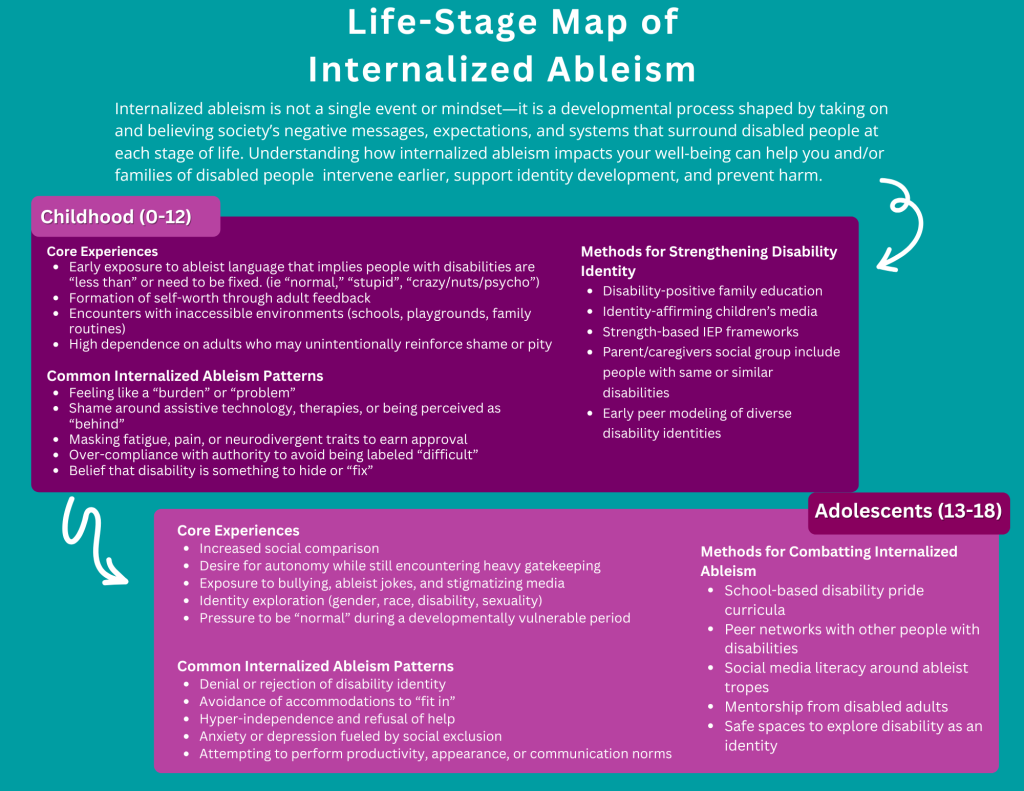
Internalized ableism is not a single event or mindset- it is a developmental process shaped by taking on and believing society's negative messages, expectations, and systems that surround disabled people at each stage of life. Understanding how internalized ableism impacts your well-being can help you and/or families of disabled people intervene earlier, support identity development, and prevent harm. 

Childhood (0-12) 
Core Experiences
- early exposure to ableist language that implies people with disabilities are 'less than' or need to be fixed (ie 'normal, 'stupid,' 'crazy/nuts/psycho") 
-Formation of self-worth through adult feedback
-Encounters with inaccessible environments (schools, playgrounds, family routines)
-High dependence on adults who may unintentionally reinforce shame or pity
Common Internalized Ableism Patterns:
Feeling like a “burden” or “problem”
Shame around assistive technology, therapies, or being perceived as “behind”
Masking fatigue, pain, or neurodivergent traits to earn approval
Over-compliance with authority to avoid being labeled “difficult”
Belief that disability is something to hide or “fix”
Methods for Strengthening Disability Identity
Disability-positive family education
Identity-affirming children’s media
Strength-based IEP frameworks
Parent/caregivers social group include people with same or similar disabilities
Early peer modeling of diverse disability identities
Adolescents (13-18) 
Core Experiences: 
Increased social comparison
Desire for autonomy while still encountering heavy gatekeeping
Exposure to bullying, ableist jokes, and stigmatizing media
Identity exploration (gender, race, disability, sexuality)
Pressure to be “normal” during a developmentally vulnerable period
Common Internalized Ableism Patterns:
Denial or rejection of disability identity
Avoidance of accommodations to “fit in”
Hyper-independence and refusal of help
Anxiety or depression fueled by social exclusion
Attempting to perform productivity, appearance, or communication norms
Methods for Combatting Internalized Ableism:
School-based disability pride curricula
Peer networks with other people with disabilities
Social media literacy around ableist tropes
Mentorship from disabled adults
Safe spaces to explore disability as an identity
Life-Stages of Internalized Ableism Continued
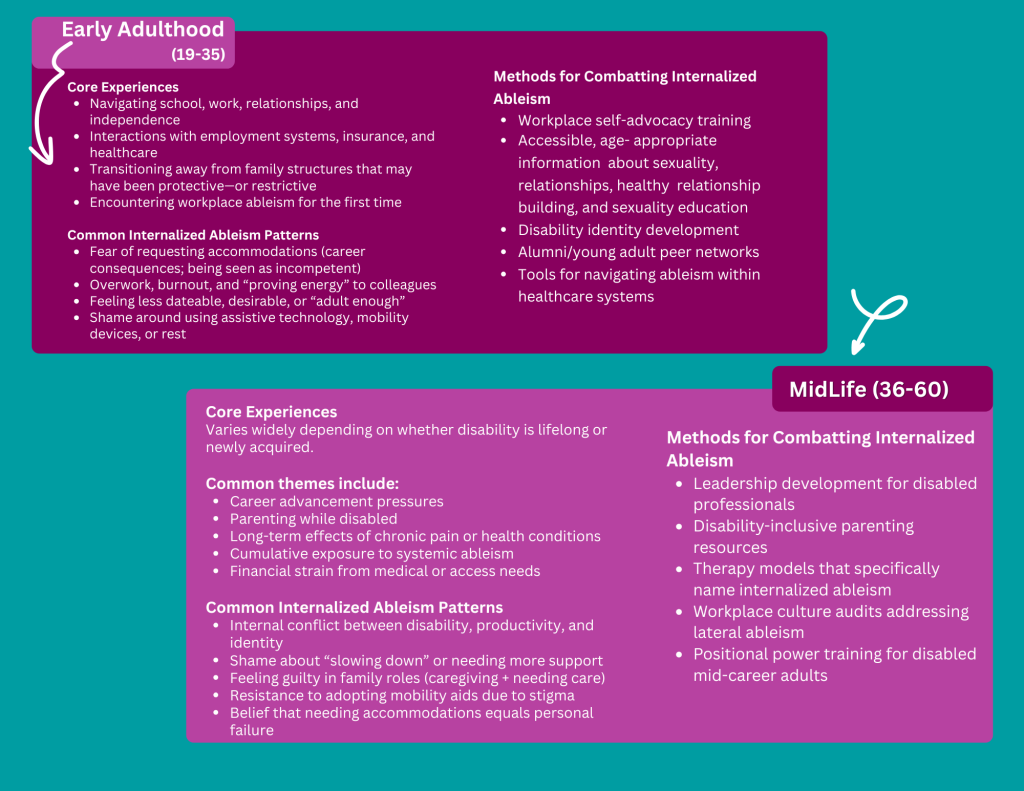
Early Adulthood (19-35) 
Core Experiences
Navigating school, work, relationships, and independence
Interactions with employment systems, insurance, and healthcare
Transitioning away from family structures that may have been protective—or restrictive
Encountering workplace ableism for the first time

Common Internalized Ableism Patterns
Fear of requesting accommodations (career consequences; being seen as incompetent)
Overwork, burnout, and “proving energy” to colleagues
Feeling less dateable, desirable, or “adult enough”
Shame around using assistive technology, mobility devices, or rest
Methods for Combatting Internalized Ableism
Workplace self-advocacy training
Accessible, age- appropriate information  about sexuality, relationships, healthy  relationship building, and sexuality education
Disability identity development 
Alumni/young adult peer networks
Tools for navigating ableism within healthcare systems

Midlife (36-60)
Core Experiences
Varies widely depending on whether disability is lifelong or newly acquired.

Common themes include:
Career advancement pressures
Parenting while disabled
Long-term effects of chronic pain or health conditions
Cumulative exposure to systemic ableism
Financial strain from medical or access needs

Common Internalized Ableism Patterns
Internal conflict between disability, productivity, and identity
Shame about “slowing down” or needing more support
Feeling guilty in family roles (caregiving + needing care)
Resistance to adopting mobility aids due to stigma
Belief that needing accommodations equals personal failure
Methods for Combatting Internalized Ableism:
Leadership development for disabled professionals
Disability-inclusive parenting resources
Therapy models that specifically name internalized ableism
Workplace culture audits addressing lateral ableism
Positional power training for disabled mid-career adults
Life-Stage Map of Internalized Ableism Continued
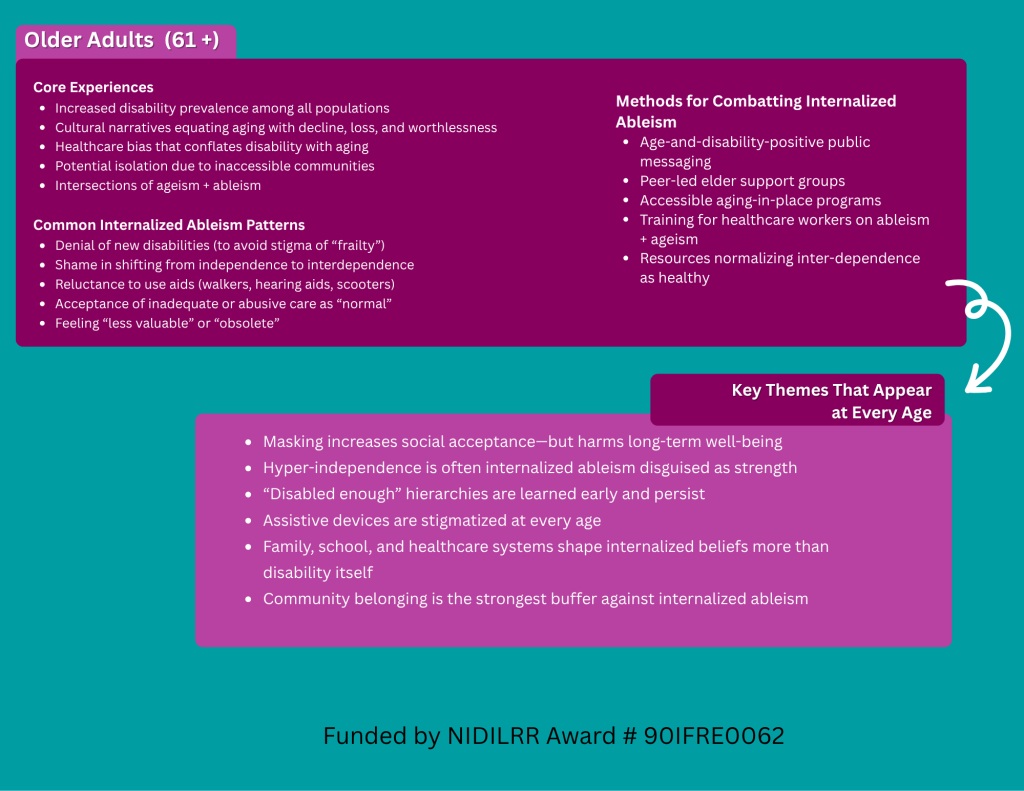
Older Adults (61+) 
Core Experiences
Core Experiences
Increased disability prevalence among all populations
Cultural narratives equating aging with decline, loss, and worthlessness
Healthcare bias that conflates disability with aging
Potential isolation due to inaccessible communities
Intersections of ageism + ableism

Common Internalized Ableism Patterns
Denial of new disabilities (to avoid stigma of “frailty”)
Shame in shifting from independence to interdependence
Reluctance to use aids (walkers, hearing aids, scooters)
Acceptance of inadequate or abusive care as “normal”
Feeling “less valuable” or “obsolete”
Methods for Combatting Internalized Ableism 
Age-and-disability-positive public messaging
Peer-led elder support groups
Accessible aging-in-place programs
Training for healthcare workers on ableism + ageism
Resources normalizing inter-dependence as healthy
Key Themes that Appear at Every Age
Masking increases social acceptance—but harms long-term well-being
Hyper-independence is often internalized ableism disguised as strength
“Disabled enough” hierarchies are learned early and persist
Assistive devices are stigmatized at every age
Family, school, and healthcare systems shape internalized beliefs more than disability itself
Community belonging is the strongest buffer against internalized ableism