To identify and reduce life-limiting inequities in healthcare, community living, and justice for all people with disabilities
Our Team
The National Center for Disability, Equity, and Intersectionalitis comprised of an interdisciplinary coalition made up of professionals, individuals with disabilities, and family members.
A gap analysis identified more than 200 sources of information about preventable healthcare inequities faced by people with disabilities. Medical guidelines are in development to make healthcare more equitable for all.
Ableism and parenting intersect in ways most people never consider—until children begin absorbing the quiet lessons our culture teaches about whose bodies are valued and whose are questioned. Simply put, ableism is the discrimination disabled people experience. However, I like Talila A. Lewis’ working definition the most. Talila is a multilingual abolitionist, artist, educator, writer, movement strategist, and community lawyer.
Presidential power and immunity shape how executive authority functions—and how accountability is enforced—in the United States. While the Constitution does not explicitly define presidential immunity, Supreme Court decisions such as Nixon v. Fitzgerald,Clinton v. Jones, and Trump v. United Stateshave clarified (and in some cases expanded) the legal protections afforded to presidents for official acts. These rulings distinguish between civil and criminal liability and raise important questions about the limits of executive power, the balance of checks and balances, and what happens when presidential actions test constitutional boundaries. Understanding these distinctions is essential for anyone engaged in civic life, policy, or advocacy, as debates about immunity directly affect democracy, governance, and the rule of law.
If ableism refers to the discrimination, marginalization, and systemic exclusion of people with disabilities, then internalized ableism occurs when disabled individuals absorb, accept, and reproduce those harmful messages about themselves—often unconsciously. This can include believing that one’s body or mind is “less than,” feeling pressure to hide or minimize disability, measuring self-worth against nondisabled standards, or assuming that access needs are burdensome or unreasonable. Internalized ableism does not arise in isolation; it is shaped by social norms, institutions, media representations, education systems, and interpersonal interactions that consistently frame disability as a problem to be fixed, pitied, or overcome.
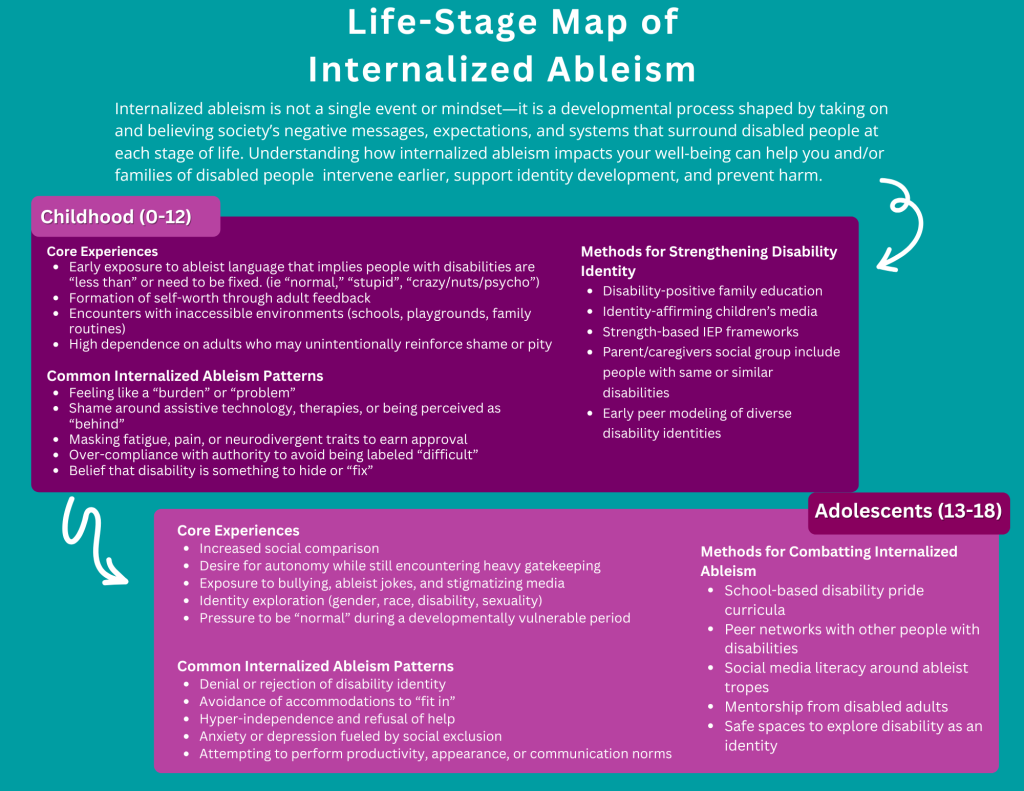
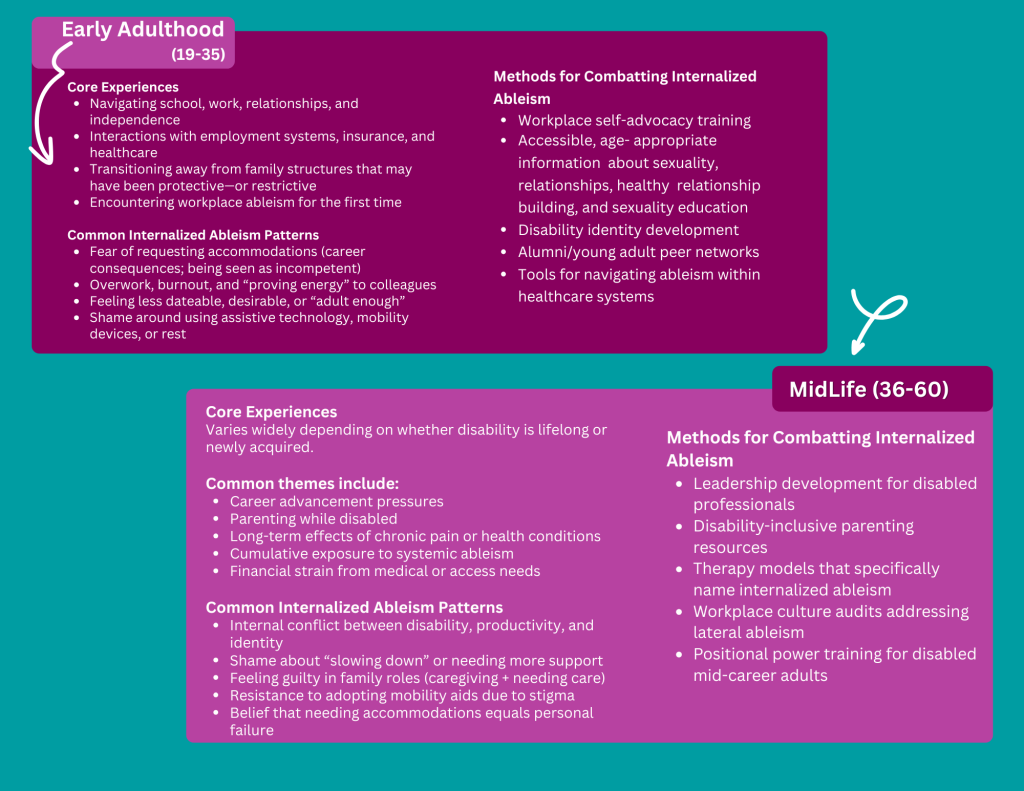
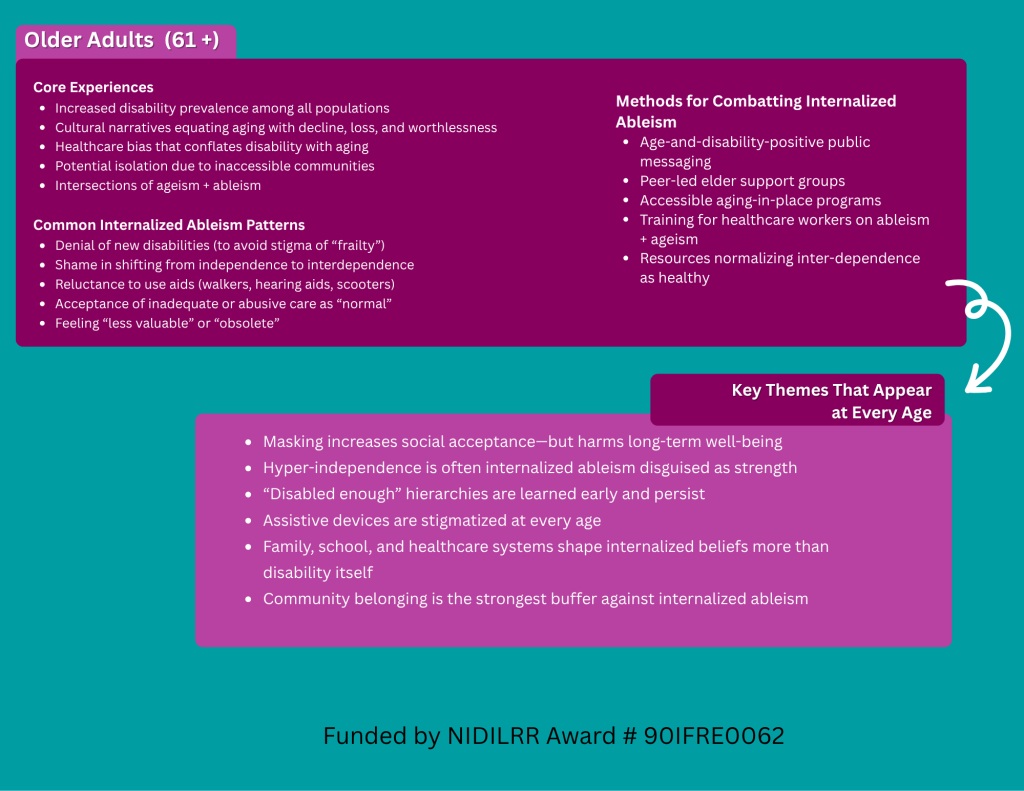
Because ableist messaging is encountered repeatedly across a lifetime, internalized ableism can evolve and take different forms depending on a person’s age, environment, and social context. From early childhood through adulthood and into later life, as people with disabilities, we may face distinct challenges, expectations, and identity negotiations that influence how we understand ourselves and our disability. Recognizing these patterns is a crucial step toward unlearning harmful beliefs and building a more affirming, empowered sense of self.
Below you will find a life-stage map outlining some common core experiences associated with internalized ableism at different phases of life, alongside practical approaches for strengthening disability identity at each stage. This map is not meant to be universal or prescriptive, but rather a reflective tool—one that acknowledges both the diversity of disabled experiences and the possibility of growth, resistance, and self-definition over time.